

Consultations and follow-ups are free
Much of what is written about thread lifts calls them a "non-surgical facelift" with "immediate, long-lasting results", "minimal downtime" and "collagen stimulation", lasting "up to two years". This guide is written by the team that offers PDO threads at our Chelsea clinic on Exhibition Road and reviewed by our clinician. It gives you what the threads are and what the regulators have cleared them for, what the studies measured and for how long, the complication rates the studies report, how we price it, what the procedure and the recovery involve, and the questions that separate a careful clinic from a careless one.
What a PDO thread lift is
Polydioxanone, PDO, is a synthetic polymer that the body breaks down by hydrolysis. Surgeons have used it for decades as a dissolving stitch; the datasheet for that suture gives absorption as essentially complete at about six to eight months, with minimal change until about three months, and no study has measured this for thread-lift threads. Thread lift threads are the same material drawn into fine filaments and, for lifting, cut with small barbs along their length so they catch in the tissue without a knot.
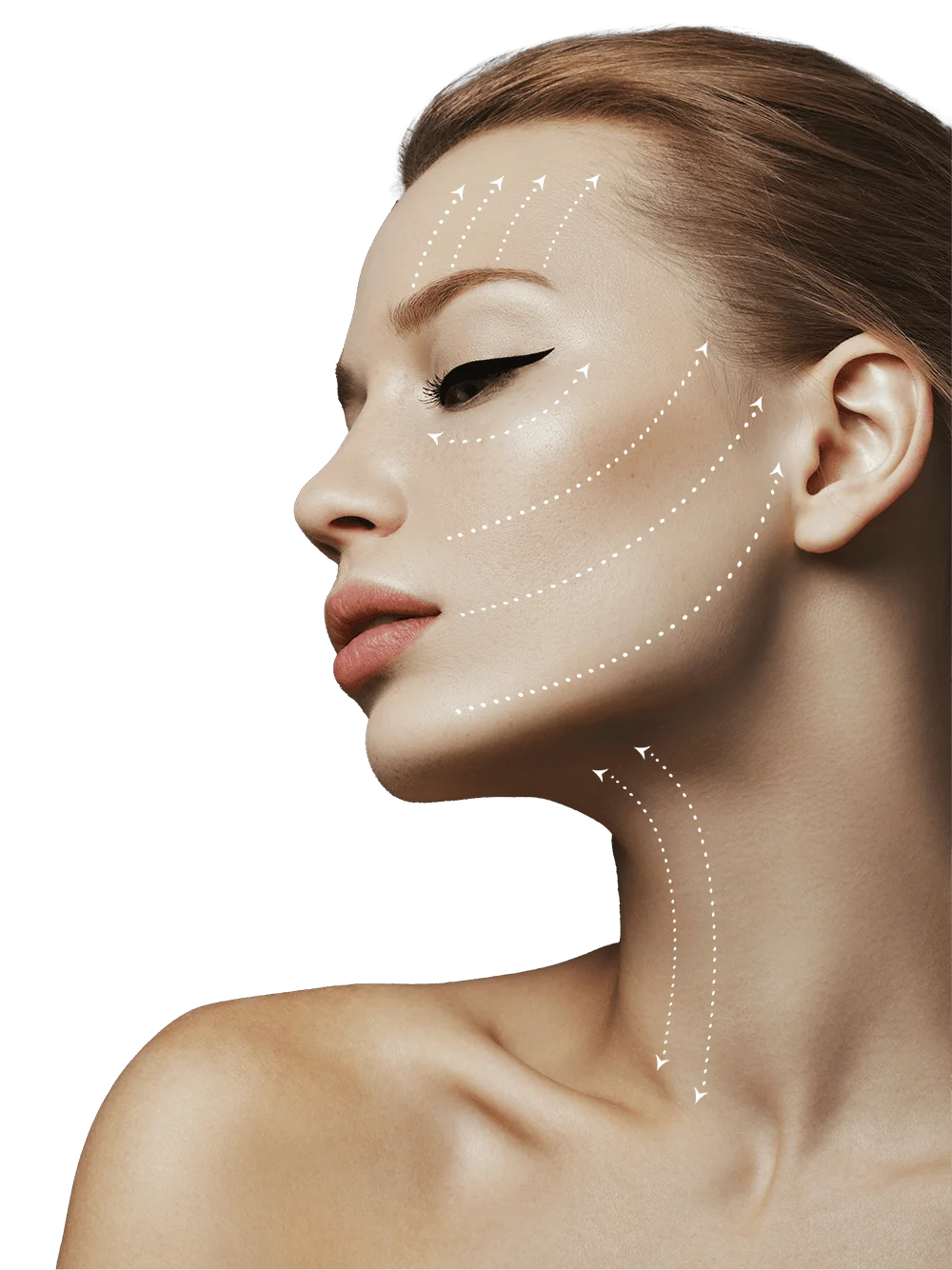
There are three kinds. Barbed or "cog" threads, with one- or two-directional barbs, are tunnelled through the fat layer under the skin on a long needle or a blunt cannula, then tightened so the barbs hold the soft tissue of the cheek, jawline, brow or neck a little higher. Smooth "mono" threads and twisted "screw" threads have no barbs and are placed under the skin without tension, sold for texture and "collagen". The newer barbed threads do not come out through the skin at the far end, and a 2025 review reports fewer complications with them.
What it is not: a facelift. A surgical facelift opens the skin, frees and repositions the deeper tissue and removes the excess. A thread lift suspends tissue from inside with a dissolving filament, and a 2017 review concluded that it should not yet be accepted as an alternative to the operation. It is also not a non-invasive treatment. It involves injected anaesthetic, needles or cannulas and implants left in the tissue, which is why the regulator of clinics in England has treated thread insertion by a healthcare professional as a surgical procedure.
What the threads are cleared for, and what they are not
- In the United States, PDO threads are 510(k) cleared as absorbable surgical sutures "for use in soft tissue approximation where use of an absorbable suture is appropriate", which means closing or holding tissue together as a stitch does. That is the wording on the 2013 clearance of one barbed PDO thread and on the 2015 clearance of another. Clearance is not approval, and none of the PDO clearances we reviewed says "lift", "facelift", "wrinkles" or "collagen".
- Two clearances exclude lifting; one allows suspension. Two PDO thread products cleared in and carry the sentence "the suture is not intended for lifting and supporting tissues", and the 2019 one limits use to the skin for dermatological applications. One PDO product family was cleared in "for use in face suspension surgery to temporarily fixate the cheek sub dermis in an elevated position", and a cone-studded thread of another polymer carries similar mid-face suspension wording. So "FDA approved" is wrong, a clearance covers only the named product, and "suspension surgery" is the regulator's own term for what a lifting thread does.
- In England, no licence is yet required to perform a thread lift. The Care Quality Commission's position, as reported in a trade journal in , is that thread insertion by a healthcare professional falls within its regulated activity of surgical procedures, so the provider must be registered for it; a non-medic faces no equivalent rule, and the register Save Face reports six-hour training courses and complaints to it about thread lifts that rose from 74 in 2020 to 213 a year later. The government's response to its licensing consultation, published in , promises that the highest-risk procedures will be restricted to regulated healthcare professionals, and the 2023 proposals put thread lifts in that top tier according to a law-firm summary; no start date has been set in England. We have not seen a UK device registration for any thread brand, and we quote no CE or UKCA status until we hold the manufacturer's declaration.
Does a PDO thread lift work? What the studies show
There is a visible lift on the day. The questions are how much, for how long, and at what rate of complications, and the published answers are less flattering than the marketing.
- The widest reviews. A 2018 systematic review of thread lift sutures found 12 studies, "very limited durability of the lifting effect", and noted that the two positive studies were sponsored by the companies making the threads. A 2021 review of 192 publications found 20 clinical studies and concluded that "no new evidence has been added to the literature to support its use", with no long-term data on how long results last or how satisfied patients stay. A 2025 systematic review of absorbable mid- and lower-face thread lifts (12 studies, 818 patients, PDO the most common material) found aesthetic scores improved immediately, complications mostly mild, the longest follow-up two years, and long-term efficacy data lacking.
- The 160-patient PDO series (2019). 160 consecutive patients had a PDO barbed thread lift. The lift was present immediately and at one month, had declined noticeably by six months and was no longer apparent at one year. 55 patients, 34%, had an early complication: superficial displacement of a thread in 11%, redness in 9%, infection in 6%, dimpling in 6%, temporary stiffness in 1%. The authors advised limiting the procedure to patients who cannot have more invasive surgery.
- The most optimistic PDO study (2018). A single-author, single-centre comparative study of absorbable barbed PDO threads reported a lift of 3 to 10 mm, "significant long-lasting effects" over a 24-month follow-up and a complication rate of about 5%, with better results when combined with other treatments. It is the best case we found for PDO threads, and it stands alone against the series above.
- Satisfaction falls with time. A 2021 meta-analysis of thread lifts of mixed materials found pooled satisfaction of 98% immediately after the procedure and 88% in the longer term.
- Collagen. The claim that smooth threads "stimulate collagen" rests on animal and laboratory work: in a rat study more filaments meant more collagen at two weeks, with a sharp fall by week twelve and the threads sitting in fibrous capsules. We found no human study that measured a collagen increase from PDO threads.
- The honest duration. Months, not years. The one series that followed PDO barbed threads systematically had the lift fading by six months and gone by twelve; the material is expected to have absorbed by about eight months on the suture datasheet. Claims of "6 months to 2 years" and "12 to 18 months" sit at the far end of a single optimistic study.
So the realistic picture: a modest lift on the day (the one study that measured it reported 3 to 10 mm over its follow-up), a softer version of it for some months, an early complication rate between about 5% and 34% depending on the study, and a need to repeat within a year if you want to keep it.
Who a PDO thread lift suits, and who it does not
It suits an adult with early to moderate sagging of the mid-face or jawline (the brow and neck have less published evidence), reasonable skin thickness, no bleeding tendency and a realistic expectation: a modest lift for some months, bought with a week or two of swelling, bruising and restrictions. It suits a patient who understands that the procedure involves needles, anaesthetic and implants, and who would rather not, or cannot, have surgery.
It does not suit, and we will say so:
- Heavy sagging, a heavy neck or marked jowls. The threads give a modest lift; a surgeon's operation does the rest. We refer you.
- Very thin skin, where in practice threads show, dimple or extrude more readily (sun-damaged skin is our own caution).
- Anyone wanting a lasting result, or who cannot accept the one-in-three early complication rate of the 160-patient PDO series.
- Anyone who wants volume rather than lift. A filler does that job; our doctor can provide one, and we will say so rather than place threads.
Who should not have it. The first four items follow clinic consent templates and the 2025 review; the rest are our own precautions, to be confirmed against the thread manufacturer's instructions at your consultation:
- Pregnancy and breastfeeding.
- An active skin infection in the area.
- A bleeding disorder, anticoagulants, or regular aspirin that cannot be paused, because the needle passes bleed.
- Autoimmune disease, where we take advice first.
- Our own precautions: a suppressed immune system, a cold sore or inflamed skin in the area, anti-inflammatory painkillers that cannot be paused, keloid or hypertrophic scarring, recent dental work or a dental infection, and surgery or another implant in the same plane.
Not sure you are suitable? Ask the clinician, it is free
What the procedure is like, step by step
- Consultation. The doctor examines your face standing and lying down, lifts the tissue with a finger to show you what a thread can and cannot do, and tells you plainly if a surgeon or an energy-based treatment is the better conversation. You get the plan (areas, thread type and count), the price and the aftercare in writing. Consultations and follow-up reviews are free.
- Marking and anaesthetic. The vectors are drawn on your skin. Local anaesthetic is injected at the entry points and along the planned paths; in our experience this is the part most people find uncomfortable.
- Placing the threads. Through a small entry point, a long needle or a blunt cannula carries each thread under the skin along the drawn line. Barbed threads are then tightened so the tissue moves up and the tail is trimmed below the skin. In our practice a mid-face and jawline lift uses several threads a side and takes about 30 to 60 minutes in all.
- Straight after. You look lifted, swollen and a little uneven, with small puncture marks and often a bruise or two. You can go home; you should not drive if you feel faint, and in our experience you will not want to be seen that evening.
- The next two weeks. Swelling and bruising settle, puckers and dimples usually ease in our experience, and the lift settles to what it will be. We review you within a week, and sooner if anything worries you.
How long it takes, when you see the result, how long it lasts
| Feature | What to expect |
|---|---|
| Procedure time | About 30 to 60 minutes including the anaesthetic, depending on the areas and the number of threads |
| First result | Immediately, with swelling; in practice the settled result at two to four weeks |
| How long it lasts | Months, not years. In the 160-patient PDO series the lift had declined noticeably by six months and was gone at one year; one single-centre study claims 24 months; the material is expected to absorb over about six to eight months on the suture datasheet |
| Repeat | When the lift has faded, in practice within a year; each repeat carries the same risks |
| Downtime | Swelling in about a third of patients in a pooled analysis of all thread types and bruising common; one to two weeks of restrictions on chewing, expression and sleeping position (a 2025 review), plus our own advice on exercise and dental work |
What a PDO thread lift costs in London
Thread lifts are priced by area and by the number of threads.
We price PDO thread lifts from a starting price, confirmed in writing at your free consultation, and we price match any comparable written quote. Consultations and follow-up reviews are free whatever you decide.
Treat a very cheap offer as a reason to ask who treats you, what is used, and what happens if something goes wrong.
Consultations and follow-ups are free
Results you can check
Thread lift photographs are easy to flatter: the "after" is taken the same day, swollen and lifted, in different light. At your consultation the doctor shows you photographs of our own patients where we have them, with their consent and taken at the same angle and distance, and in our practice you compare your own at the two-to-four-week review and again at six months, which is when the honest comparison is. Our reviews are collected through review.clinic, and the badge on this page links to them: 4.8 out of 5 from 53 reviews in October 2026. Read them as experiences, not as trial results.
PDO thread lifts compared with the alternatives
| Feature | PDO thread lift | Ultrasound energy devices (Ultherapy, Sofwave) | Radiofrequency with muscle stimulation (EMface) | Surgical facelift |
|---|---|---|---|---|
| What it is | Absorbable barbed threads placed under the skin to suspend tissue | Ultrasound energy delivered through the skin, no implant | Heat plus electrical muscle stimulation through pads, no needles | An operation under anaesthetic that repositions and removes tissue |
| Invasive | Yes: anaesthetic, needles or cannulas, implants left in | No | No | Yes |
| Result | A modest lift on the day, fading over months | Gradual, per each device's guide | Gradual, per its guide | The change the thread reviews measure against |
| Evidence | Reviews 2018 to 2025 call the long-term data limited; the 160-patient PDO series 34% early complications | Device-specific trials; see each guide | Device-specific trials; see its guide | Surgical series; not reviewed here |
| We offer it | Yes | Yes, at our sister clinics | Yes, at our sister clinic | No; we refer you |
Threads vs ultrasound and radiofrequency devices. No trial compares them, so nobody can tell you one "outperforms" the other. The defensible differences: energy devices leave no implant in the tissue, so thread-specific problems such as migration and extrusion do not arise; threads give an immediate mechanical lift that the devices do not. A 2016 position of the Dutch plastic surgery society, hosted on the British association's website (it is not a BAAPS statement), judged that threads add no value over established energy-based devices; it is an opinion and it is dated, but it is the opinion of surgeons.
Threads vs a surgical facelift. Not alternatives. A 2017 review concluded thread lifting should not yet be accepted as a substitute for the operation, and the 160-patient PDO series advised threads only for patients who cannot have surgery. If you want a lasting change, a surgeon is the conversation to have, and we refer you.
Threads vs cone threads. Cone-studded threads of a different polymer are a separate product with a separate US clearance for temporary mid-face suspension; they are not PDO, and we have not reviewed their evidence here. We do not offer them.
Threads vs fillers or Botox. Different jobs: a filler adds volume, a toxin relaxes muscle, a thread suspends tissue; our doctor can provide all three and will say which, if any, fits. If you have had filler in the same area, tell us: a thread in the same plane is a reason to wait or to decline.
Consultations and follow-ups are free
Side effects, and the risks to weigh
Expected: swelling (35% of patients in a pooled analysis of 26 studies of all thread types), bruising at the entry points and along the thread paths, tenderness, a tight or stiff feeling when you chew or smile, and small puckers or dimples where the barbs pull, which in practice mostly ease over one to two weeks.
Common enough to plan for: dimpling (10% pooled across all thread types, 6% in the 160-patient PDO series), a thread displaced too superficially (11% in that series), altered sensation (6% pooled), infection (2% pooled, 6% in the PDO series), and extrusion of a thread end through the skin (2% pooled). Older patients had more dimpling and infection in the pooled data, and the older thread type that exits the skin had more bleeding and dimpling than the newer type in a 2025 review.
Rare and serious, mostly reported with older non-absorbable threads and not ruled out with any thread: migration of a thread, injury to the parotid duct or a branch of the facial nerve, persistent pain or a foreign-body feeling, granulomas, and a thread that has to be removed, which is harder than putting it in. Save Face, the register, describes serious infections and vascular occlusions in women treated outside medical settings and names the causes as wrong training, wrong placement and wrong threads.
Three risks deserve more attention than they get. First, asymmetry and over-correction on the day that only settles partly, which is why we place conservatively and review early. Second, the repeat cycle: because the lift fades within the year, the honest cost is the price per year, and each repeat carries the same risks. Third, the practitioner: in England this is a surgical-type procedure that anyone may perform, and the complaint figures are a reason to ask.
How to choose a thread lift clinic in London
- Ask who holds the needle and what they are registered as. Ours is Dr Marie Duggan, GMC 7488383, the doctor who also reviews this guide.
- Ask to see the provider's CQC registration for surgical procedures at the address where you will be treated, since the regulator has counted thread insertion by a healthcare professional as one.
- Ask what thread, which brand, and for its UK paperwork. If the answer is "FDA approved", ask which clearance: most are for a stitch, two say in writing that they are not for lifting, and one PDO family is cleared for face suspension surgery.
- Ask how long it lasts and where the number comes from. Months is what the trial data show; two years is the best case of one single-centre study.
- Ask for the complication rate the clinic quotes and what happens if a thread shows, dimples, migrates or gets infected, and who removes it.
- Ask for the plan in writing: areas, thread type and count, the price, the review date and the aftercare.
- Treat "non-surgical facelift", "lunchtime lift", "no downtime", any promise of no pain, "clinically proven", "stimulates collagen by X%" and "FDA approved" as warning lights. The advertising regulator's guidance says "non-surgical" and "alternative to surgery" can mislead by implying surgical results.
Aftercare
Our aftercare, which we give you in writing: cold compresses for the first evening; sleep on your back with your head raised for about a week; no wide mouth opening, hard or chewy food, facial massage, pressing or rubbing for one to two weeks; no make-up over the entry points for 24 hours; no saunas, steam, pools, hard exercise or alcohol for about a week; no dental treatment for two weeks unless urgent, and tell the dentist; keep the entry points clean and dry. Tell us straight away about spreading redness, increasing pain, a thread you can see or feel at the surface, a lump, a change in sensation that does not settle, or any weakness of the face, and come to the review within a week whether or not anything worries you.
Consultations and follow-ups are free
Frequently asked questions
How much does a PDO thread lift cost in London?
We price PDO thread lifts from a starting price by area and by the number of threads, confirmed in writing at a free consultation, and we price match any comparable written quote. Consultations and follow-up reviews are free.
How long does a PDO thread lift last?
Months, not years. In the 160-patient PDO series the lift had declined noticeably by six months and was gone at one year, and the material is expected to absorb over about six to eight months on the suture datasheet. One single-centre study claims 24 months and is the best case we found. Plan on a repeat within a year if you want to keep the effect.
Is a thread lift a non-surgical facelift?
No. It involves injected anaesthetic, needles or cannulas and implants left under the skin, the regulator of clinics in England has treated thread insertion by a healthcare professional as a surgical procedure, and a 2017 review concluded it should not yet be accepted as an alternative to a facelift. The advertising regulator's guidance warns that "non-surgical" and "alternative to surgery" can mislead by implying surgical results.
Is it worth it?
If you have early to moderate sagging, understand that the lift is modest and lasts months, and accept the complication rates in the studies, it can be a reasonable choice over doing nothing. If you want a lasting change, a surgeon is the honest conversation; if you want a treatment that leaves nothing in the tissue, ask about our sister clinics' energy-based treatments.
Does it hurt?
The anaesthetic injections sting; in our experience the thread placement is felt as pressure and tugging rather than pain once the area is numb. Afterwards expect tenderness, tightness and soreness on chewing for a week or two. We do not promise no pain.
What is the downtime?
Swelling in about a third of patients in the pooled studies and bruising are the norm, with puckers and dimples that in practice usually ease, and one to two weeks of restrictions on chewing, expression and sleeping position (a 2025 review), plus our own advice on exercise and dental work. Plan around any event by at least two weeks. "No downtime" is not what the studies describe.
What are the side effects and risks?
Common: swelling (35% pooled across all thread types), bruising, tenderness, stiffness, dimpling (10% pooled), a displaced superficial thread (11% in the 160-patient PDO series), altered sensation (6%), infection (2% to 6%), extrusion (2%). In the 160-patient PDO series a third had an early complication. Rare and serious: migration, nerve or duct injury, persistent pain, granulomas, and threads that have to be removed.
Are PDO threads FDA approved?
No. In the United States PDO threads are 510(k) cleared, which is a clearance, not an approval: most as absorbable sutures for holding tissue together, two since 2019 with the written exclusion that the suture is not intended for lifting and supporting tissues, and one product family since 2023 for face suspension surgery. Ask which product your clinic uses. We quote no UK device status until we hold the manufacturer's declaration.
Do PDO threads stimulate collagen?
The evidence is from animals and laboratory work: in a rat study more filaments meant more collagen at two weeks and much less by week twelve. We found no human study that measured a collagen increase from PDO threads, so we do not sell smooth threads on that claim.
Which areas can be treated?
The published studies cover the mid-face and the lower face; the brow and the neck have less published behind them. Offers to treat the body or "any sagging area" go beyond the evidence.
How many threads do I need?
It depends on the area and the tissue, and there is no published standard. We tell you the count and the price in writing before you decide.
Who should not have a thread lift?
Anyone pregnant or breastfeeding, anyone with an active infection in the area, a bleeding disorder or blood thinners that cannot be paused, autoimmune disease without advice, very thin skin, or heavy sagging that needs a surgeon. As our own precautions, inflamed skin or a cold sore, keloid scarring, recent dental work and filler in the same plane are reasons to wait.
Can threads be removed?
Sometimes, and it is harder than placing them. A superficial thread end can be trimmed; a misplaced or infected barbed thread may need a small procedure to find and remove, and in practice threads that have started to dissolve cannot always be retrieved. Ask any clinic who would do this for you before you book.
Thread lift or Ultherapy?
No trial compares them. Threads give an immediate mechanical lift that fades over months and leave material in the tissue; micro-focused ultrasound works through the skin and leaves nothing behind, so thread-specific problems do not arise. Our sister clinics offer the ultrasound and radiofrequency options and we will say which suits you.
What is a fox eye thread lift?
A brow and outer-eye lift with threads. The same material, the same durability and the same complication list apply, and in practice the thin skin at the temple adds the risks of asymmetry and visible threads. The studies we reviewed did not cover brow lifts with threads, so there is less evidence than for the mid- and lower-face.
Who performs the procedure and where?
Dr Marie Duggan, GMC 7488383, the doctor who reviews this guide, at our Chelsea clinic at 8 Exhibition Road. The CQC has treated thread insertion by a healthcare professional as a regulated surgical procedure in England, so before you book anywhere, ask to see the provider's CQC registration for surgical procedures at the address where you will be treated.
Where is the clinic and how do I book?
PDO Threads Clinic, 8 Exhibition Road, London SW7 2HF, a short walk from South Kensington station. We are open Monday to Friday 9am to 7pm and Saturday 9am to 6pm. Consultations and follow-up reviews are free. Call 0207 043 8107 or use the form below. If you would rather be contacted by e-mail only, tell the team member who calls to book you and we will switch to e-mail.


