
These are the questions people ask about PDO thread lifts, grouped by topic. The price comes first because it is one of the questions asked most; the figure is given in writing at the free consultation, and the rest is answered here. Call 0207 043 8107 or use the form below.
Price and the plan
How much does a PDO thread lift cost in London?
A thread lift is priced by the area and by the number of threads, confirmed in writing at your free consultation, with a price match on any comparable written quote. Consultations and follow-up reviews are free. The written plan names the areas, the thread count and the review dates.
How many threads do I need?
It depends on the area and the drop: in the 160-patient PDO series, two or three threads a side on the cheeks and two to four along the jawline. The doctor counts them for your face at the consultation and writes the number down.
Does the consultation cost anything?
No. Consultations and follow-up reviews are free.
Results
Is it worth it?
For an early drop of the cheeks or jawline in someone who wants a modest lift now and accepts a result of up to about a year, in our clinical judgment yes. It is done under local anaesthetic in 30 to 60 minutes. The studies show a real but temporary lift with mostly mild complications; it is not a substitute for a facelift, and the clinician says so when that is the right answer.
How long does a PDO thread lift last?
Up to about a year: the threads dissolve over six to eight months. The 160-patient PDO series found the lift noticeably less by six months and gone by one year, and the professional register Save Face gives six to twelve months. The immediate lift relaxes as the swelling settles, Save Face describes the result improving gradually over two to three months, and a repeat is planned only once it has faded.
Is a thread lift a facelift without surgery?
No. It is placed through small entry points under local anaesthetic, with threads left to dissolve, and it gives a modest lift for up to about a year; a facelift is an operation that repositions and removes tissue. For someone who wants a small lift now rather than surgery, it is the right tool; for heavy sagging it is not.
Do PDO threads stimulate collagen?
In a rat study more filaments meant more collagen at two weeks, and much less by week twelve; we describe the lift as mechanical, held by the tissue that firms around the threads, and fading as they dissolve.
Pain, downtime and risks
Does it hurt?
The local anaesthetic injections sting; the threads themselves are felt as pulling and pressure rather than pain, in our experience. Afterwards expect tenderness, tightness and soreness on chewing for a week or two, and smiling pulls for the first days.
What is the downtime?
A week or two of swelling, tightness and some bruising. Entry points that heal in days in our experience; no massage, facials, wide mouth opening or hard food for one to two weeks; no sauna, hard exercise or alcohol for about a week; no dental treatment for two weeks. Most people are back at a desk within a few days in our experience, with make-up from the second day.
What are the side effects and risks?
In the 160-patient PDO series, 34% had an early complication: a thread that moved in 11%, redness in 9%, infection in 6%, dimpling in 6%, stiffness in 1%. Across 26 studies of all thread materials: swelling in 35%, dimpling in 10%, altered sensation in 6%, infection in 2%, a thread working out in 2%. A thread you can see or feel: 4% across the same studies. Rarer: nerve or gland injury, granulomas and a thread that migrates (a 2025 review), and infections after nose threading in one series of seven patients. The doctor goes through them with you before you consent.
Can threads be removed?
Sometimes. A thread end that shows can be trimmed, and a thread that has moved or become infected may need a small procedure under local anaesthetic to find and remove it. In our practice a thread that has started to dissolve cannot always be retrieved, and the body absorbs it over six to eight months.
Areas and alternatives
Which areas can be treated?
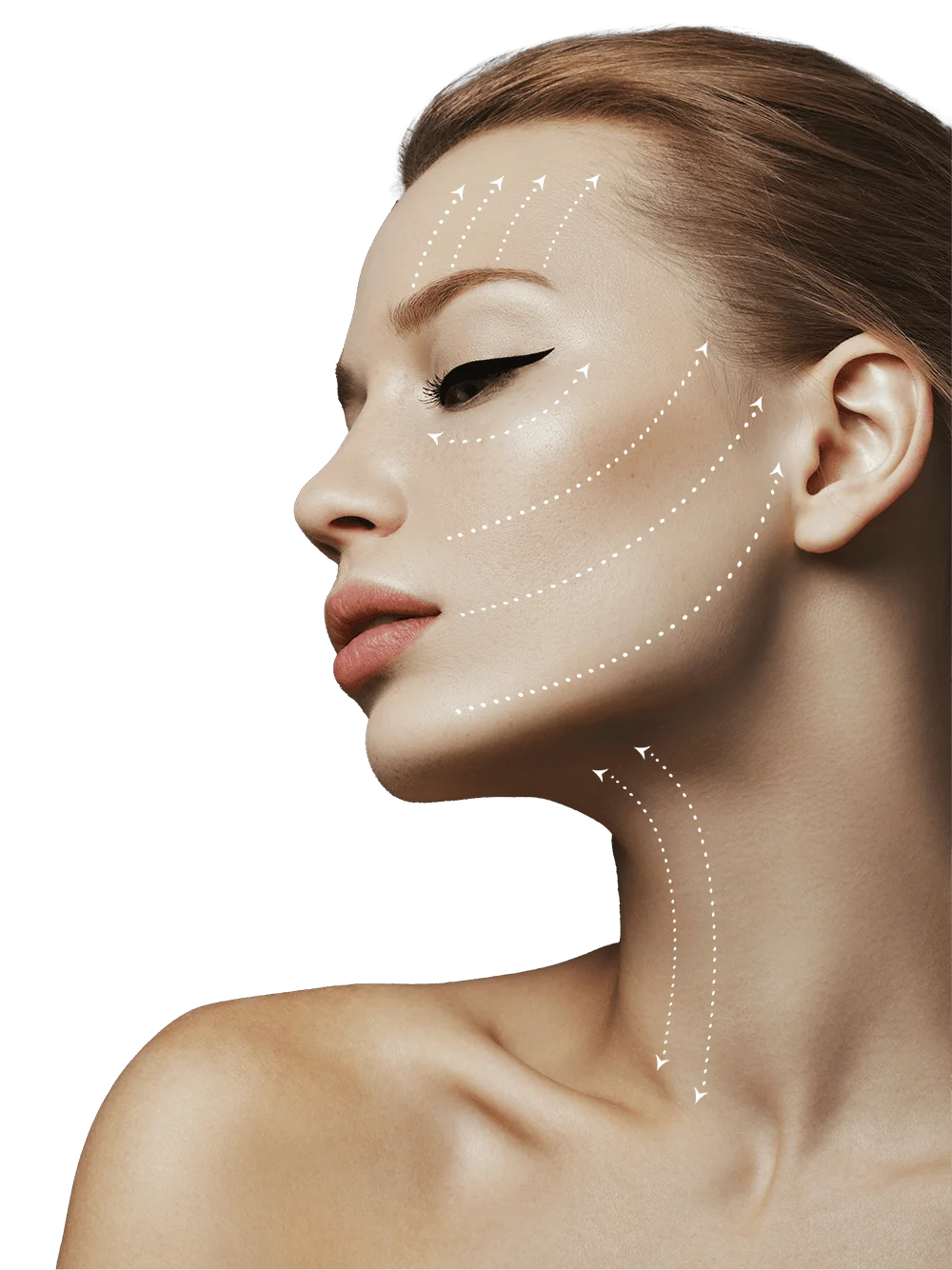
On the face we place threads in the cheeks and mid-face, the jawline and jowls, the brow, the forehead, the nose, under the eyes, the nasolabial folds and the marionette lines. On the neck and under the chin we place them for lines and laxity, and on the body in the décolletage, the arms, the abdomen, the buttocks and the breasts. The US lifting clearances cover the mid-face only and the cheeks have the trials, which the cheeks and jawline page explains. The brow and the nose have small published series, and the neck rests on one maker's wording and our practice. The body areas rest on a review, one study alongside liposuction and our practice, so the doctor says at the consultation what to expect for them.
Which types of thread do you use?
Barbed (cog) and cone threads lift; mono, screw and twisted threads are placed for lines, texture and soft volume without lifting. PDO dissolves in about six to eight months, PLLA in about twelve and PCL in twelve to eighteen. We use every type where it fits, and the doctor says which is right for your area.
What is a fox eye thread lift?
Threads placed from the temple to lift the tail of the brow and the outer corner of the eye, angled upwards and outwards. It uses the same PDO threads as a face thread lift, no US clearance covers it, and two small studies of 29 and 15 patients measured the brow raised at three months and twelve weeks.
Thread lift or Ultherapy?
Threads move tissue; Ultherapy tightens it. A thread lift gives a visible lift on the day that holds for up to about a year. Ultherapy gives no lift on the day and a gradual tightening over three to six months that holds for around a year in our experience. A dropped cheek or jawline suits threads, loose skin suits Ultherapy, and some faces are planned for both. We provide both.
Are PDO threads FDA approved?
No. In the US, PDO threads are FDA-cleared, which is a finding of equivalence to earlier devices, not approval. The lifting clearances are only for the mid-face, and several other PDO threads are cleared as sutures with the statement that they are not intended for lifting. We do not name a thread brand on these pages; ask the doctor which thread is used for your area.
Who it suits
Who should not have a thread lift?
Anyone pregnant or breastfeeding, with an active skin infection, cold sore or inflamed skin. Anyone with a bleeding disorder, blood thinners, regular aspirin or anti-inflammatory painkillers that cannot be paused, an autoimmune disease without the doctor's advice first, or a suppressed immune system. Anyone with keloid scarring, recent dental work, or surgery or another implant in the same layer. Very thin skin and heavy sagging do not suit it, and the doctor says so.
Who performs the procedure and where?
Dr Marie Duggan, GMC 7488383, the doctor who reviews our guides, at PDO Threads Clinic, 8 Exhibition Road. Ask any provider who holds the needle and what they are registered as.
Where is the clinic and how do I book?
PDO Threads Clinic, 8 Exhibition Road, London SW7 2HF, a short walk from South Kensington station. Call 0207 043 8107 during opening hours (Monday to Friday 9am to 7pm, Saturday 9am to 6pm) or use the form below at any time and we call you back.
Not sure you are suitable? Ask the clinician, it is free

